Compost vs Mulch: What’s the Difference and Which Does Your Soil Need?
20,626 views
If you’ve ever stood in a garden center staring at bags labeled compost, mulch, soil conditioner, and organic matter, you’re not alone. For many gardeners and nature lovers, these terms can feel interchangeable.
They’re not.
Understanding compost vs mulch can make the difference between plants that merely survive and soil that genuinely thrives. While both improve garden health, they serve very different roles. One feeds the soil from within. The other protects it from above.
And here’s the important part: your garden may need both.
According to the U.S. Department of Agriculture, compost improves soil structure, enhances water retention, and supports beneficial microbial life, while mulch helps conserve moisture, reduce erosion, and regulate soil temperature.
So which one does your soil actually need?
Let’s dig in.
What Is Compost?
Compost is decomposed organic matter transformed into a dark, crumbly, nutrient-rich soil amendment.
It’s created when natural materials like:
Fruit and vegetable scraps
Dry leaves
Grass clippings
Coffee grounds
Plant debris
break down through microbial activity over time.
Think of compost as nature’s recycling system.
Its primary job is to improve the soil itself.
What Compost Does for Soil
Finished compost helps by:
Improving soil structure
Increasing organic matter
Supporting beneficial microbes
Improving water retention in sandy soils
Enhancing drainage in heavy clay soils
Slowly releasing nutrients
Healthy soil isn’t just dirt—it’s a living ecosystem. Compost helps rebuild that ecosystem.
The USDA Agricultural Research Service notes that compost can significantly improve rainfall infiltration and reduce runoff and erosion, making it valuable beyond simple fertilization.
Best Uses for Compost
Compost works best when:
Mixed into garden beds before planting
Added around vegetables
Used to amend poor soil
Top-dressed around established plants
Added to raised beds
Incorporated into lawn repair areas
Potential Downsides of Compost
Compost is excellent—but not foolproof.
Possible drawbacks include:
Overapplication can create nutrient imbalances
Poorly finished compost may contain pathogens or weed seeds
Compost alone doesn’t suppress weeds effectively like mulch
Some composted manures can increase phosphorus excessively if overused
University extension guidance warns that repeated heavy compost applications without soil testing can create nutrient issues over time.
What Is Mulch?
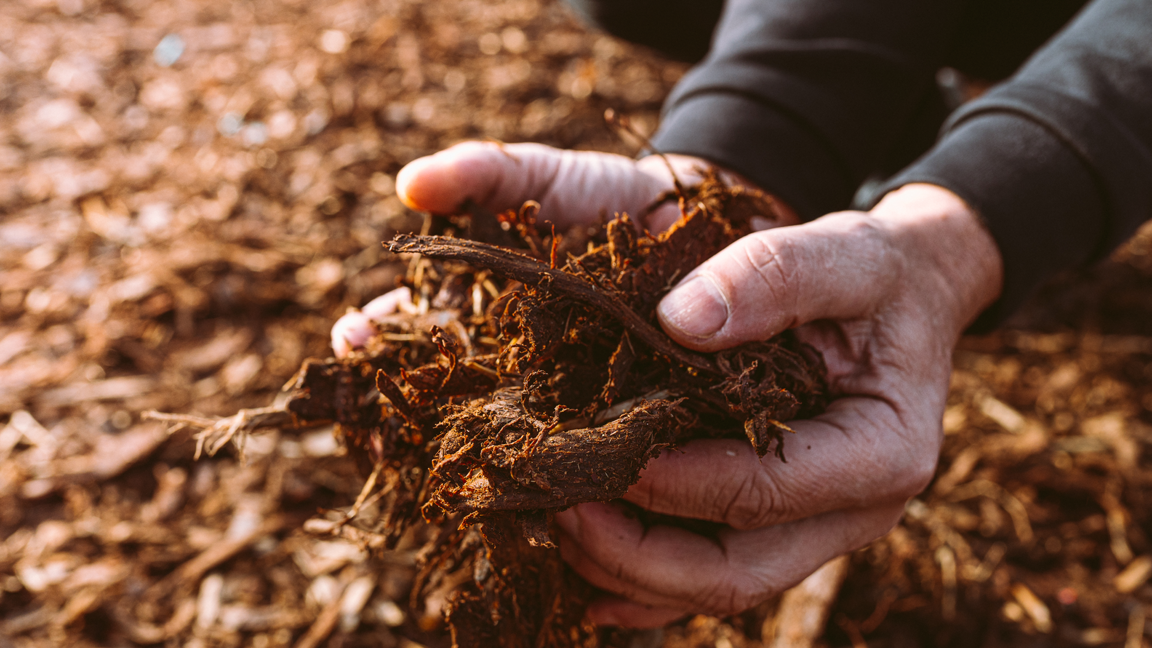
Mulch is any material spread over the soil surface to protect it.
Unlike compost, mulch is usually not mixed into the soil.
Its main role is protection—not feeding.
Mulch can be:
Organic Mulch
Organic mulch breaks down over time.
Examples include:
Wood chips
Bark
Straw
Shredded leaves
Grass clippings
Pine needles
Compost (yes, compost can also be used as mulch)
Inorganic Mulch
These do not decompose.
Examples:
Gravel
Stone
Landscape fabric
Rubber mulch
University of Minnesota Extension defines mulch as a protective surface layer that helps conserve moisture, suppress weeds, and moderate soil conditions.
What Mulch Does for Soil
Mulch creates a protective barrier.
Its benefits include:
Moisture Retention
Bare soil dries quickly.
Mulch slows evaporation, meaning less watering.
This is especially valuable in hot summers and drought-prone gardens.
Weed Suppression
Mulch blocks sunlight from reaching weed seeds.
Fewer weeds means less competition for nutrients and water.
Temperature Regulation
Mulch acts like insulation.
It helps:
Keep roots cooler in summer
Protect roots from winter temperature swings
Erosion Control
Heavy rain can compact or wash away exposed soil.
Mulch softens impact and reduces runoff.
Gradual Organic Matter Addition
Organic mulches slowly break down and contribute organic matter over time.
But this is secondary—not their primary purpose.
Compost vs Mulch: The Core Difference
Here’s the simplest explanation:
Compost improves the soil. Mulch protects the soil.
Feature | Compost | Mulch |
|---|---|---|
Main purpose | Feed and improve soil | Protect soil surface |
Nutrient content | Moderate to high | Usually low |
Placement | Mixed into/top-dressed on soil | Spread over soil surface |
Weed suppression | Minimal | Excellent |
Moisture retention | Moderate | High |
Soil structure improvement | Excellent | Indirect over time |
Microbial activity | Strong support | Some support (organic types) |
Temperature control | Limited | Strong |
Appearance | Functional | Often decorative |
That’s the real compost vs mulch difference.
Which Does Your Soil Need?
The answer depends on your soil problems.
Choose Compost If Your Soil Is:
Compacted Clay
Clay holds water but often drains poorly.
Compost loosens dense structure and improves aeration.
Sandy and Nutrient-Poor
Sandy soils drain too quickly.
Compost helps retain both moisture and nutrients.
Low in Organic Matter
If soil looks lifeless, dusty, or unproductive, compost helps rebuild biological activity.
Supporting Heavy Feeders
Vegetables like:
Tomatoes
Squash
Peppers
Corn
benefit from compost-enriched soil.
Choose Mulch If Your Soil Is:
Drying Out Too Fast
Mulch dramatically reduces evaporation.
Overrun With Weeds
A proper mulch layer is one of the easiest weed management tools.
Exposed to Temperature Extremes
Mulch protects root systems from heat and cold stress.
Prone to Erosion
Sloped beds especially benefit.
When You Should Use Both
This is where experienced gardeners gain an edge.
The best soil strategy often combines compost and mulch.
Here’s the ideal sequence:
Step 1: Add compost to improve soil biology and fertility
Step 2: Water well
Step 3: Add mulch on top for protection
This creates a system where:
compost feeds the soil
mulch preserves the benefits
It’s a highly effective combination for:
vegetable gardens
flower beds
fruit trees
shrubs
native landscaping
Common Mistakes to Avoid
Using Fresh Wood Chips as a Soil Amendment
Fresh woody materials mixed into soil can temporarily tie up nitrogen during decomposition.
Keep coarse wood mulch on the surface.
Piling Mulch Against Tree Trunks
“Mulch volcanoes” are a common landscaping mistake.
They can encourage:
rot
pests
disease
Keep mulch a few inches away from stems and trunks.
Using Too Much Compost
More isn’t always better.
Repeated thick applications can lead to nutrient overload.
A soil test helps guide long-term amendment decisions.
Confusing Decorative Mulch With Soil Improvement
Dyed bark mulch may look neat, but appearance alone doesn’t equal soil health.
Practical Compost and Mulch Recommendations
Vegetable Gardens
Best combo:
1–2 inches compost mixed in
2–3 inches straw or shredded leaf mulch
Why?
Vegetables need fertility and moisture stability.
Flower Beds
Best combo:
light compost top-dressing
bark mulch surface layer
Trees and Shrubs
Best choice:
Mostly mulch.
Established woody plants usually need:
moisture regulation
root protection
weed suppression
Compost only if soil quality is poor.
Raised Beds
Raised beds lose moisture faster.
Use both:
compost for fertility
mulch for water conservation
Expert Insight: Soil Health Is Bigger Than Fertilizer
Modern soil science increasingly focuses on biology—not just nutrients.
Healthy soils support:
fungi
bacteria
earthworms
nutrient cycling
water infiltration
The USDA Natural Resources Conservation Service emphasizes soil organic matter as a foundation for resilient soils because it improves water storage, nutrient cycling, and structure.
Compost directly contributes to that biology.
Mulch helps protect the conditions that biology needs.
That’s why the “either/or” question often becomes “both.”
FAQ
Is compost better than mulch?
Not necessarily.
They do different jobs.
If your soil lacks nutrients and organic matter, compost is better.
If your problem is weeds or moisture loss, mulch is better.
Can compost replace mulch?
Partially.
Compost used as a surface layer offers some mulch-like benefits.
But it usually breaks down faster and suppresses weeds less effectively than bark or straw mulch.
Can mulch turn into compost?
Organic mulch eventually decomposes into organic matter similar to compost.
But this process is slower and less controlled.
How often should I add compost?
For most home gardens:
once or twice yearly
Vegetable beds often benefit from annual additions.
How often should mulch be replaced?
Depends on type.
Typical timelines:
straw: several months
shredded leaves: seasonal
bark mulch: 1–2 years
wood chips: longer
Is bagged compost as good as homemade?
Often yes—if high quality.
Look for:
fully finished compost
earthy smell
crumbly texture
no large undecomposed chunks
Final Verdict: Compost vs Mulch
If you remember only one thing, make it this:
Compost feeds the soil. Mulch shields the soil.
They solve different problems.
Choose compost when your soil needs rebuilding.
Choose mulch when your soil needs protection.
Choose both when you want the healthiest long-term results.
For nature-focused gardeners, that combination mirrors how ecosystems work naturally: organic matter enriches the ground while fallen leaves protect it from the elements.
That’s smart gardening—and healthier soil for years to come.
compost vs mulch
mulch guide
compost benefits
soil moisture
soil amendmentz
Found this helpful? Share it!
5 Comments
J
Jean Merveil AHONGA
Peace and Love
Replying to
S
saiful islam
on off
Replying to
S
saiful islam
jkjkj
Replying to
N
nonono
no no no no
Replying to
F
FS
JAIME CA
Replying to