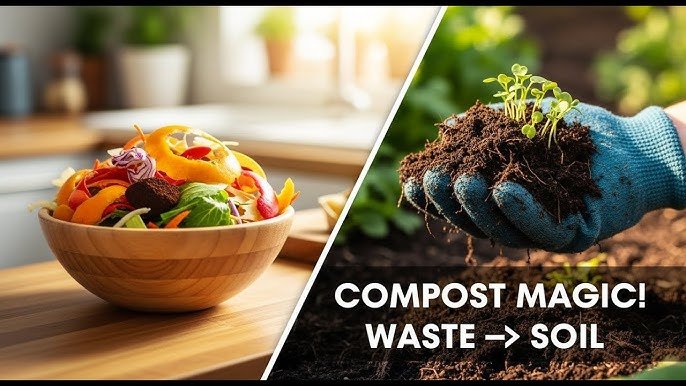
Beginner Composting Guide: Turn Kitchen Waste into Rich Soil
20,197 views
Introduction: Why Composting Matters More Than Ever
Here’s a surprising reality: food waste contributes nearly 10% of global greenhouse gas emissions . That banana peel or leftover rice you throw away doesn’t just disappear—it decomposes in landfills without oxygen, releasing methane, a potent climate pollutant.
At the same time, composting is exploding in popularity. Cities worldwide have increased composting initiatives by 24% between 2023 and 2025 , and even households are adopting compact composting systems.
This guide isn’t another generic “green vs. brown” explanation. You’ll learn how to actually compost efficiently at home—without smells, pests, or confusion—and how to turn everyday kitchen scraps into high-quality soil.
What Composting Really Does (Beyond the Basics)
Most beginner guides say compost “adds nutrients.” That’s true—but incomplete.
Composting improves soil in three deeper ways:
- Microbial life boost: Compost introduces billions of beneficial microbes that help plants absorb nutrients more effectively.
- Water retention: Compost can increase soil water retention by up to 20–30%, reducing watering needs.
- Carbon storage: It locks carbon into soil instead of releasing it into the atmosphere.
Real-world example:
A small balcony gardener using compost mixed with potting soil reduced watering frequency from daily to every 2–3 days—especially useful in warm climates.
What You Can (and Shouldn’t) Compost
✅ Compost-Friendly Materials
“Greens” (Nitrogen-rich):
- Fruit and vegetable scraps
- Coffee grounds and tea bags
- Fresh grass clippings
“Browns” (Carbon-rich):
- Dry leaves
- Cardboard and paper (non-coated)
- Sawdust (untreated wood)
❌ Avoid These (Beginner Mistakes Happen Here)
- Cooked food (unless advanced system)
- Meat, dairy, oily foods
- Glossy or plastic-coated paper
- Diseased plants
Non-obvious tip:
Eggshells are great—but crush them first. Whole shells take months to break down.
Step-by-Step: How to Start Composting at Home
Step 1: Choose Your Composting Method
Best options for beginners:
| Method | Best For | Pros | Cons |
|---|---|---|---|
| Open bin | Backyard homes | Cheap, simple | Slower |
| Tumbler | Fast results | Easy mixing | Higher cost |
| Bokashi | Apartments | Handles cooked food | Needs extra step |
| Electric composter | Urban users | Fast (24–48h) | Expensive |
Expert insight:
If you’re in a humid tropical area (like coastal regions), tumblers work better because they reduce excess moisture buildup.
Step 2: Get the Right Ratio (The #1 Success Factor)
Aim for 2–3 parts “browns” to 1 part “greens.”
Too many greens → smelly, slimy pile
Too many browns → dry, slow decomposition
Simple rule:
Every time you add kitchen scraps, cover them with dry material.
Step 3: Layer Your Compost Correctly
- Start with coarse browns (twigs/cardboard) for airflow
- Add greens (food scraps)
- Cover with browns
- Repeat in layers
Step 4: Maintain Moisture (The “Sponge Test”)
Your compost should feel like a damp sponge:
- Too wet → add cardboard or dry leaves
- Too dry → sprinkle water lightly
Step 5: Turn or Mix Regularly
- Turn pile every 5–7 days (or rotate tumbler)
- This adds oxygen and speeds up decomposition
Step 6: Wait and Harvest
- Fast systems: 3–6 weeks
- Traditional bins: 2–4 months
Finished compost looks:
- Dark brown
- Crumbly
- Earthy smell (like forest soil)
A Beginner’s Real Composting Journey (What Actually Happens)
Week 1:
You’re excited. You add scraps daily.
Week 2:
You notice a slight smell. You panic. (Normal—fixable with browns.)
Week 3:
The pile shrinks. You realize composting is basically controlled decay.
Week 4–6:
You get your first usable compost—and suddenly, throwing away food feels wrong.
This emotional shift is real: many beginners report becoming more mindful about food waste after starting composting.
Hidden Mistakes Most Guides Don’t Talk About
1. Overloading with Citrus or Onion
These can slow microbial activity if overused.
Fix: Keep them under 10–15% of total waste.
2. Ignoring Particle Size
Large chunks take much longer to decompose.
Pro tip:
Chop scraps into 2–5 cm pieces to speed things up.
3. Composting Too “Clean”
A sterile pile lacks microbial diversity.
Better approach:
Add a handful of soil or old compost to kickstart activity.
4. Sealing the Bin Too Tightly
Composting needs oxygen.
No airflow = rot, not compost.
The Real Cost of Composting (2026 Breakdown)
Here’s what beginners often overlook:
Budget Options
- DIY bin: $0–$20
- Basic tools: $10–$30
Mid-range Setup
- Compost tumbler: $80–$200
High-end (Urban Convenience)
- Electric composter: $300–$800
Insight:
The global composting machine market is booming—projected to reach $28.4 billion by 2034 —but most beginners don’t need expensive tech to succeed.
Composting in Small Spaces (Apartment-Friendly Guide)
No backyard? No problem.
Option 1: Bokashi System
- Ferments food waste (even meat)
- Needs follow-up composting or soil burial
Option 2: Indoor Compost Bin
- Use charcoal filters to control odor
- Empty every 2–3 days into larger system
Option 3: Community Composting
Growing trend in urban areas—shared compost sites reduce individual effort.
Advanced Tips That Actually Improve Results
1. Use “Compost Activators” (Smartly)
Instead of buying expensive products:
- Add coffee grounds
- Add grass clippings
- Use aged compost
2. Monitor Temperature (Optional but Powerful)
Active compost piles reach 50–65°C (122–149°F)
Higher temps:
- Kill pathogens
- Speed up decomposition
3. Add Diversity for Better Soil
The more varied your inputs, the richer your compost.
Think:
- Fruit peels + leaves + paper + coffee grounds
Downsides & Reality Check (What No One Tells You)
Let’s be honest—composting isn’t perfect.
❗ It Can Smell (If Done Wrong)
But this is usually fixable in minutes.
❗ It Takes Time
Even “fast” composting requires patience.
❗ Pests Can Appear
Especially if food is exposed.
Solution: Always cover fresh scraps.
❗ Not All Waste Fits
You’ll still produce some non-compostable waste.
Environmental Impact: Why Your Compost Matters
- Reduces landfill waste (organic waste can be ~28% of household trash)
- Cuts methane emissions
- Improves soil health naturally
- Supports circular economy practices
With global waste expected to rise to 3.8 billion tonnes by 2050 , small household actions like composting scale into massive impact.
FAQ: Beginner Composting Questions
How long does composting take?
Anywhere from 3 weeks (electric systems) to 3–4 months (traditional bins).
Does composting smell bad?
No—if balanced correctly. Bad odor means too many greens or too much moisture.
Can I compost cooked food?
Not in basic systems. Use Bokashi or advanced composters.
How do I know compost is ready?
It should look like dark soil and smell earthy—not like food.
Is composting worth it for small households?
Yes. Even a single person can reduce waste significantly and produce useful soil.
Conclusion: Start Small, But Start Now
Composting isn’t just a sustainability trend—it’s becoming a practical necessity as waste levels rise globally. The good news? You don’t need fancy equipment or perfect conditions.
Start with a simple bin. Learn by doing. Adjust as you go.
beginner composting
kitchen waste compost
homemade compost
organic gardening
composting tips
rich soil guide
Found this helpful? Share it!
5 Comments
S
shalini
jgftydhjbkjh
Replying to
D
Daniel Tessore
Thanks
Replying to
K
khakha khikhi
محتوي جيد
Replying to
A
GOOD https://naturecycle.net/beginner-composting-guide-turn-kitchen-waste-into-rich-soil
Replying to
M
Thanks🙏
Replying to